“Knowledge is of no value unless you put it into practice.”
– Anton Chekhov
Weekly Focus: Abhyasa (practice)
Abhyasa translates as practice. Practice and repetition are essential pieces to finding consistency and growth — key to finding a steadiness in your yoga routine.
Any modality and any skill requires practice. This could be a physical skill but it could also be a mental practice such as meditation, gratitude, or self-reflection. Practice builds the skeleton and framework for continued growth and expansion into new explorations. Yoga is a modality. Yoga is a skill. Yoga is a practice. Yoga is a spiritual commitment that requires daily attention, focus and practice, as the structure towards self-realization.
Yoga invites us to engage with ourselves in ways that may not feel natural in the busy-ness of the modern world. Self-reflection, removal of distraction, body awareness and autonomy, intuition — these are not commonly valued in modern society. To consciously invite these engagements in, we must practice.
Consider the protective and structural support of a skeleton — securing our vital organs and holding us upright. This is what practice does for us in Yoga. The more we practice becoming aware of ourselves, the more we practice listening to and observing our bodies, the more this becomes a protective structure of our lives providing us with agency, autonomy, empowerment, and peace.
In what ways do you practice protecting yourself? In what ways do you practice growth? Do you see yoga as a protective and structural practice? What structures do you have in place to support you feeling safe in who you are?
Passive Pose of the Week: Supta Matsyendrasana (supine twist)
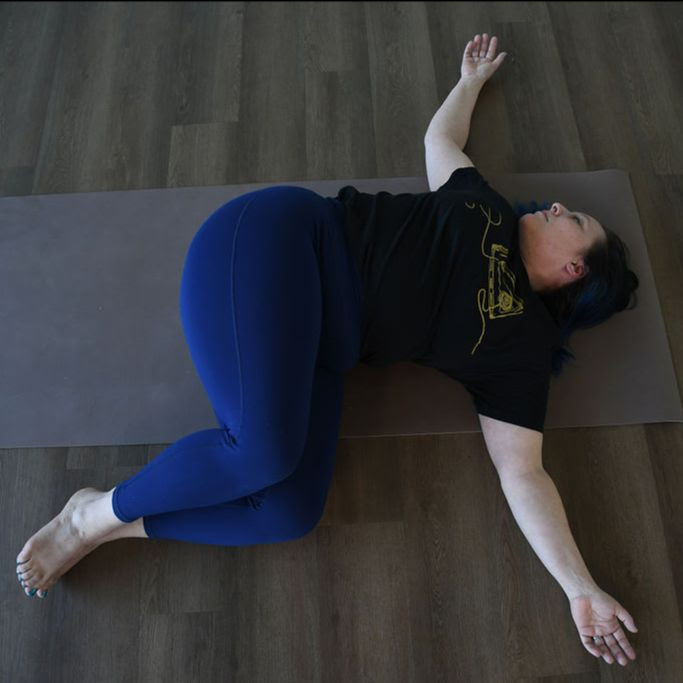
Supta Matsyendrasana encourages a practice of release. Invite yourself to practice settling in, releasing your distractions and attuning to your breath in the pose.
- Begin lying on your back.
- Bend the knees and plant your feet on the floor.
- Lift your hips and shift them to the left side of your mat. Let your knees drop to the right. The knees can stay bent or straighten. They might be staggered or stacked.
- Take your arms wide letting your chest spread across the floor. If it is comfortable, look to your left.
- Hold the post for 5 – 7 breaths before switching side. As you come through center, pause for a moment in a neutral position, and then move to your left side.
Supta Matsyendrasana is a lovely twist for the entire spine, but depending on our anatomy, we may mostly experience this in the hips. The good news — there are options we can take to help us deepen the twist from hips to neck. If you are twist with your knees to the right and cannot feel your left shoulder on the ground, try elevating your right shoulder slightly by placing the corner of a blanket underneath. Does that allow you to drop your left side closer to the floor? If your top leg has a hard time staying in the twist try weighting the hip with a sandbag or heavy folded blanket. Does this allow the hips to release more into the twist? Practice offering yourself support and see how it can enhance your practice rather than taking away from.
Active Pose of the Week: Kakasana (crow pose)
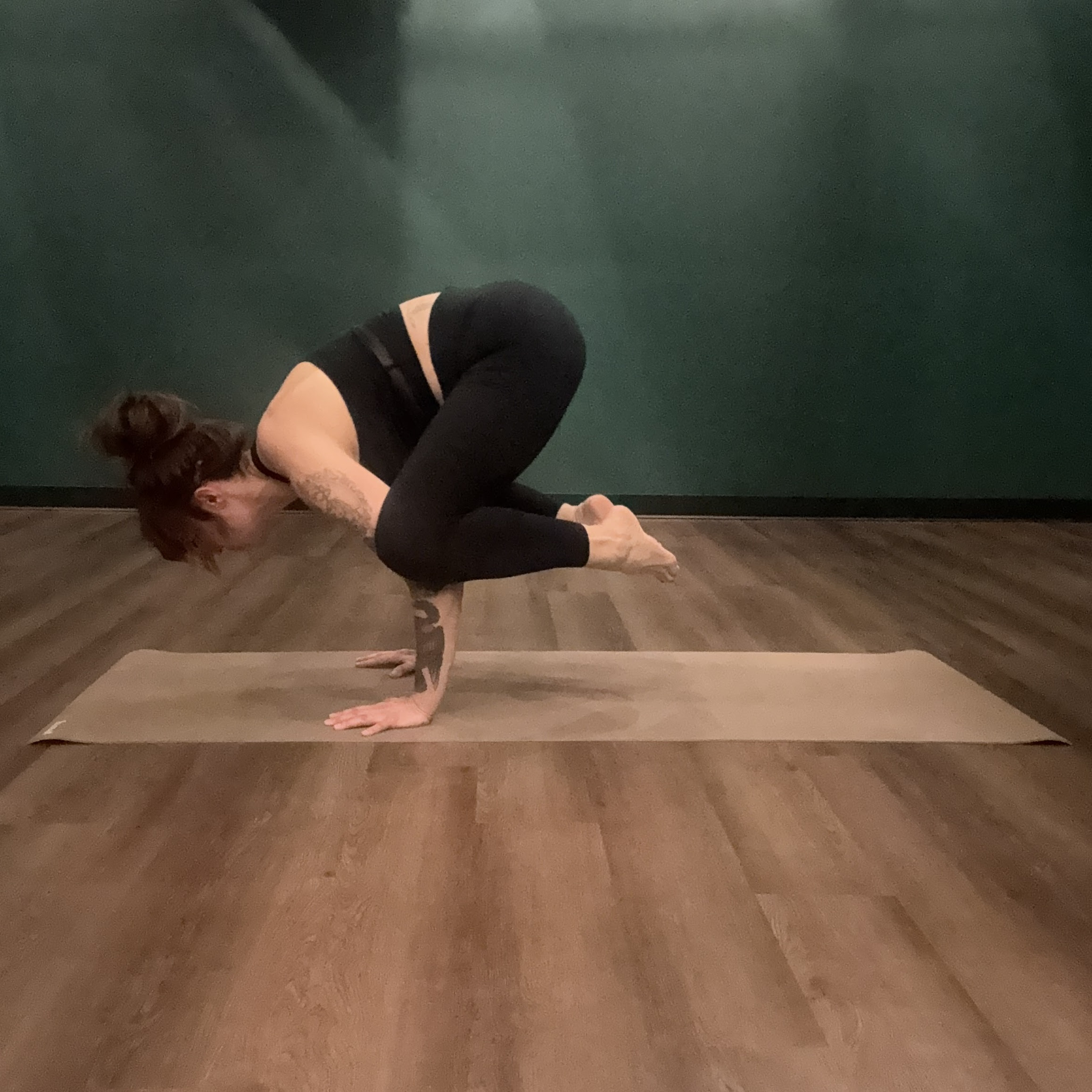
Kakasana is a challenging arm balance both physically and mentally, requiring practice and perseverance. Remind yourself that the benefits are in the journey of the pose and not in the final destination. There is nothing to achieve but curiosity.
- Begin in a squat position.
- Lean forward so that you can place your hands on the ground, about shoulders-width distance apart.
- Bend your elbows and lean forward further, keeping your gaze forward of your hands.
- Lift one knee at a time to your elbows, using them as a shelf. Squeeze the knees in towards your midline as you think about shifting your weight forward. Imagine pulling your tailbone down making yourself more compact in the pose.
- Remember to breathe as you focus!
- Hold as long as you are able before pausing for rest.
Kakasana is hard! It takes practice, focus and patience. The practice in Kakasana is not only about finding the right balance and shift in weight, but also in focusing your mind and trusting yourself. Building confidence in ourselves is a practice just as much as any physical skill or strength. If you find that the mental aspect is getting in the way, try supporting yourself by placing a blanket, bolster or pillow in front of your face, a soft space to land should you need it. There is so much to learn about ourselves in Kakasana — what does this pose teach you about yourself outside of the physical engagement?
Join us in class this week to practice your practice! See the full schedule HERE.
To get weekly updates from our parent brand, Myriad Fitness + Yoga, follow our weekly podcast “For Time.”