“When we transcend our own thoughts, we get in touch with the womb of creation.” – Deepak Chopra
Weekly Focus: Samadhi (glimmer of infinity – oneness)
Samadhi is a transcendent state where we move into a space of oneness. In this space, you transcend the intellect, and no longer distinguish between yourself and reality, you simply exist. Within samadhi, you simply are, and simply observe, seeing life in its true working. The edges between yourself and the world around you begin to blur and fuzz, until there is not separation at all.
Each weekly focus this month has progressed and led us to understanding this state of Samadhi – the ultimate goal of Yoga. A teacher of mine recently refered to samadhi as “a glimmer of infinity.” We find samadhi in those moments of stillness, sometimes so brief, where everything seems to stand still, and you simply exist. These moments may come in the pause between our breaths, during our meditations, or the pauses between postures, the subtle spaces between.
Describing samadhi is challenging, as it may not be a state that we have experienced before. To transcend our experience on earth is to see ourselves both separate from and at the same time unified with all things. When we transcend this experience, the mind stops observing the division between ourselves and all else, and we are able to just exist.
Do not confuse samadhi with enlightenment, or a destination, such as a concept like heaven. Samadhi is not a state we are meant to stay in. We catch glimpses of samadhi that remind us there is more to who we are than our waking state. The reminder of this state helps us find more release and respite from the grind of everyday life, knowing that this toil is not our only goal, our only end game. There is more to embrace than toil and task.
Here are some spaces to notice stillness, and to seek samadhi :
- The pause between breaths — find time to breathe intentionally. Counting your inhales and exhales is a great way to invite this practice. Let each inhale and exhale pace to a count of four. Make sure the tempo is comfortable for you, so that you never feel depleted of air. Pause briefly at the top of your inhale, and briefly before the next breath in. What do you observe in these spaces?
- The gaps in our thoughts — find time to meditate for 10, 20 or 30 minutes. A guided meditation may work best here. We recommend Insight Timer to find some free offerings. There may be moments where your mind is simply floating, undisturbed by thoughts or sensations. What do you observe in these spaces?
- The transitions between postures — find time to practice on your mat. Take a class or guide yourself, for many a class with repetitive movement may be helpful here. Slow down the movement between poses. When the body is focused on smoothing our and settling into a new position, what is the mind doing? What do you observe in these spaces?
Passive Pose of the Week: Savasana (corpse pose)
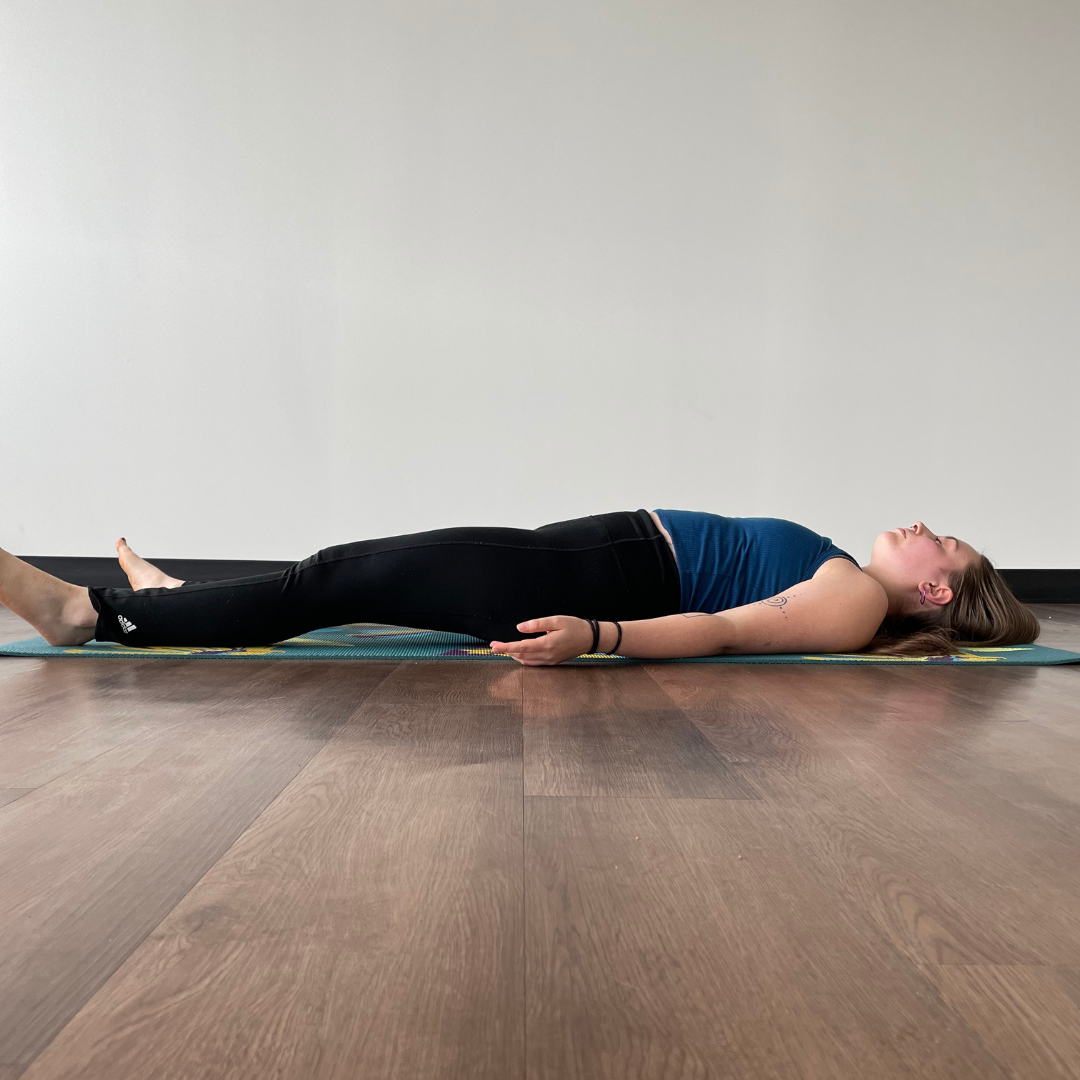
From the words of, Melissa Smith-Wilkinson: “We use savasana as a means for rest and stillness to counter the doing-ness of life. Savasana dives deep into our state of being-ness by becoming “dead” to what is around us and our circumstances and alive to what is inside of us. Here we can find a state of respite, renewal and dharana or steady mind. It is a time for allowing and forgoing resistance. A place of santosha or acceptance of where we are.”
- Come to lie down on the floor, on your back.
- Make sure you are very comfortable, use any props you like.
- If the ground is cold, you can unfold a blanket to lie on rather than a yoga mat.
- You might prop your knees with a rolled blanket or a pillow. Your head can be slightly elevated with thin pillow or lightly folded blanket.
- If you are chilly, cover up with a blanket! Remove all the distractions you can.
- Set a timer and rest for 10 – 15 minutes.
Have you ever tried savasana lying on your belly, or even on your side? These can be nice alternatives if your back just isn’t quite correct for the day. For a belly down savasana, you might place a blanket under your forehead or forearms, so you can prop the head for supported breathing. On your side, you may like to squeeze a bolster between your legs and rest your head on a support. Try them out! Different days may call for different set ups.
Active Pose of the Week: Sirsasana (supported headstand)

Sirsasana brings us back to our sahasrara connection, our ability to flip our perspective, our narrative, and to embrace something beyond the mundane.
- Begin in tabletop pose on hands and knees.
- Interlace your fingers and place them on the ground, forming a triangle from you hands to your elbows.
- Place the crown of your head (the flat and highest most point on the head!) on the ground, nestling your head into your hands.
- Tuck your toes, lift your knees, and start to walk your feet in towards the head. You might stop here.
- To progress, walk the feet in until the hips stack over the shoulders. Brace through the knee and begin to pull the knees into your chest. You might stop here.
- To progress, straighten one leg at a time overhead. Squeeze the legs together and point through the toes. Push down strongly through the arms.
- Hold for 3 – 5 breaths and carefully lower.
If you haven’t tried headstand before, we recommend practicing near a wall. This will give you support both mentally and physically in the pose. The trick to headstand is to push really hard through the forearms and to engage the shoulders well, so that you reduce the amount of pressure on your head. This will feel much more comfortable for most of us. Remember, there are progressions listed above for headstand. If this is new to you, get comfortable with the preliminary positions first, and then build up to the full position.
Join us in class this week to reflect on Samadhi. See the full schedule HERE.
To get weekly updates from our parent brand, Myriad Fitness + Yoga, follow our weekly podcast “For Time.”