“Silence is the sleep that nourishes wisdom.” – Francis Bacon
Weekly Focus: Citta Vrtti (mind chatter, distraction)
Citta is our consciousness and vrtti translates as “wave.” We can think about citta vrtti as the rough waves upon the surface of choppy water — turbulent, disturbing of the stillness, the uneven. We often refer to these “waves” as mind chatter or monkey mind — the distracting thoughts that constantly keep our mind a flurry of activity.
A quiet mind allows space for rest for our thoughts and emotions. A space to nurture internally is equally important as external nurture.
We can think of the mind like a body of water — often quick and turbulent, rapid and choppy. Turbulent waters are difficult to pass and require constant attention and action. A calm body of water allows you to sail smoothly with less worry and anxiety. Taking time to rest the mind is equally as important as resting the body. It is in this space of silence and nurture that we allow ourselves to slow down and observe more.
In what ways do we over-exhaust the mind? How can we carve out more time for a quiet mind?
Often time, finding quiet space in the mind also means quiet space in our external surroundings. How often are you filled with the hum of sound? Ambient noise, music, conversation, TVs, podcasts — with so much external distraction, how should we expect ourselves to easily silence the running thoughts? Here are a few ways to consider building quiet time into your day:
- Try starting your morning in silence. A clear mind at the start of the day allows you to slowly regulate and adjust to activity. Use your daily commute as a time to sit in silent reflection, no music, no podcast.
- Offer yourself a mid-day walk in silence. You will still hear the world around you, but you might enter your own space more clearly without your headphones nestled into the ear.
- Try any monotonous and simple chore in silence: vacuuming, folding laundry — this can be a great time to keep your hands busy but enter a space of reflection and deep thought. This is especially helpful if holding stillness and quite is challenging — the activity of the hands may help to hold your focus.
Passive Pose of the Week: Halasana (plough / deaf man’s pose)
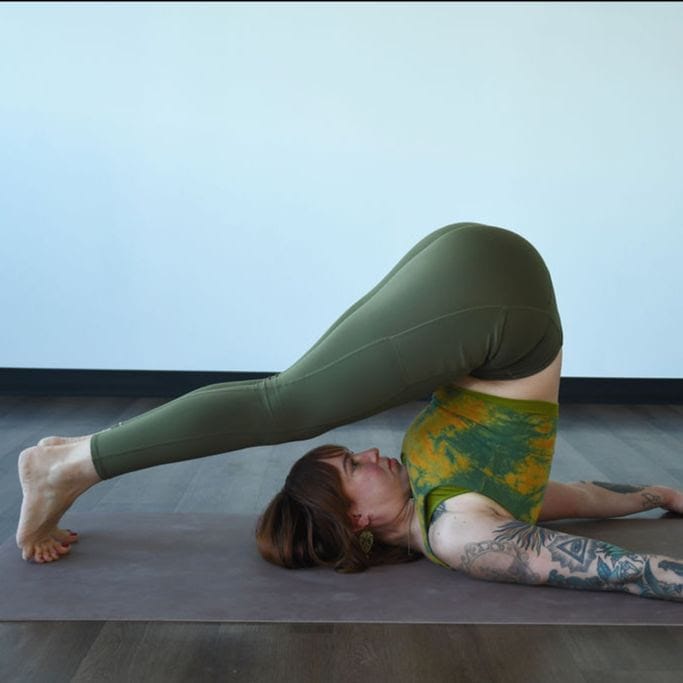
Allow your body to be a physical blockade to the various distractions around you in halasana.
- Begin on your back with the feet on the floor and the knees pointed towards the ceiling, similar to the setup for bridge pose.
- Use momentum from the legs to lift your hips off the floor and catch your seat with your hands. Your knees will stay tucked in as you do.
- Once you have your hands to the hips or seat, start to move your hands further up the back, helping the hips to lift hight over the chest and shoulders.
- Once the hips stack over the shoulders, straighten the legs behind you so that the feet come over head. Lower the feet to the ground behind the head.
- Your hands can stay at the low back as a support, or, if the feet touch the ground, allow the hands to press into the ground beside you.
- After you take several breaths here, use the hands to act as brakes at the low back, helping you to lower back down with control.
Plough pose is the first step towards deaf man’s pose. To come into deaf man’s pose, once your feet touch the ground, bend your knees and bring them to the outsides of the ears. This will block your vision and deafen surrounding noises. Remember to find your breath here, it is easy to hold your breath in the posture, so focus on smooth, easy inhales and exhales.
Active Pose of the Week: Sarvangasana (shoulder stand)
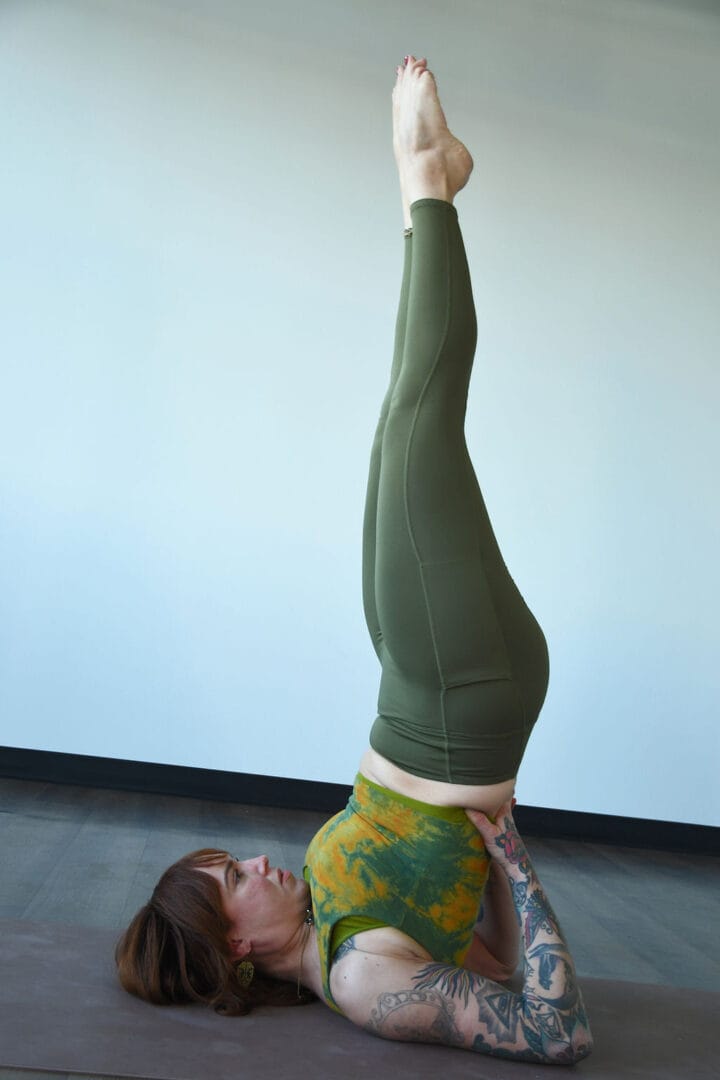
This pose literally translates as “all body parts pose” — practice drawing your awareness to only one thing at a time, reducing external distraction.
- Begin as you did for plough pose.
- Using your momentum, you will catch the hips or seat with the hands.
- Walk your hands further up the back until the hips lift over the chest or shoulders.
- Straighten your legs overhead to the ceiling above you.
- Squeeze the legs together to make them strong and lifted. Keep the hands at the back for support.
- Take 5 – 7 breaths. When you are ready to come down, you might pass through plough pose. Do use your hands to help guide your hips and legs back down to the floor slowly.
A fun way to explore shoulder stand might be to take this pose at the wall. Come into legs up the wall, but start with your butt a little further away from the wall than normal — about a shin’s distance. Bend the knees and press the soles of your feet into the wall. Use the pressure of your feet agianst the wall to lift your hips up in a support shoulder stand. This is a great way to get the hips high over the chest or shoulders that uses less strength in the core and more effort in the legs / glutes. Not to mention, the traction of the foot against the wall is very grounding and might feel great!
Join us in class this week to seek to help quiet your citta vrtti! See the full schedule HERE.