“Life blossoms when it is in a state of harmony and balance.”
– Angie Karan Krezos
Weekly Focus: Sthira Sukha Asanama (balance of effort & ease)
Balance is at the heart of the yoga practice, a foundational principle. Balance is also an essential tool in keeping our inner foundation from cracking, shearing, or crumbling.
Consider your home. What would happen if the foundation was off balance? Imbalance would follow in all areas of the structure leading to slanted floors, shifty walls, everything a bit askew. Balance is essential to holding things upright.
We work through the practice of balance on our mats in many ways by literally balancing on one foot, by balancing our effort and our ease, by balancing our breath. Funny enough, stira sukha asanam is the singular line within the Yoga Sutras (one of the guiding texts for a yoga practice) that references the postural practice of yoga (asana). So, how can we take this consideration off the mat and into our daily lives?
What does effort and ease look like in day-to-day living? Is it an appropriate work-life balance? Perhaps acquiring enough sleep? Maybe it is a balance of personal alone time and time spent with friends and loved ones?
Balance is deeply personal and only understood when we are familiar with what that feels like in our body. This week, we take time to consider and recognize our personal tipping points, and how we can work to keep all things steady to the best of our abilities.
What does balance mean to you? If you imagined your life feeling balanced and steady, what would that mean? What changes would you make? What would stay the same? How does balance look for your inner landscape (thoughts, reactions, emotions)?
Passive Pose of the Week: Supta baddha konasana (supine cobbler’s pose)
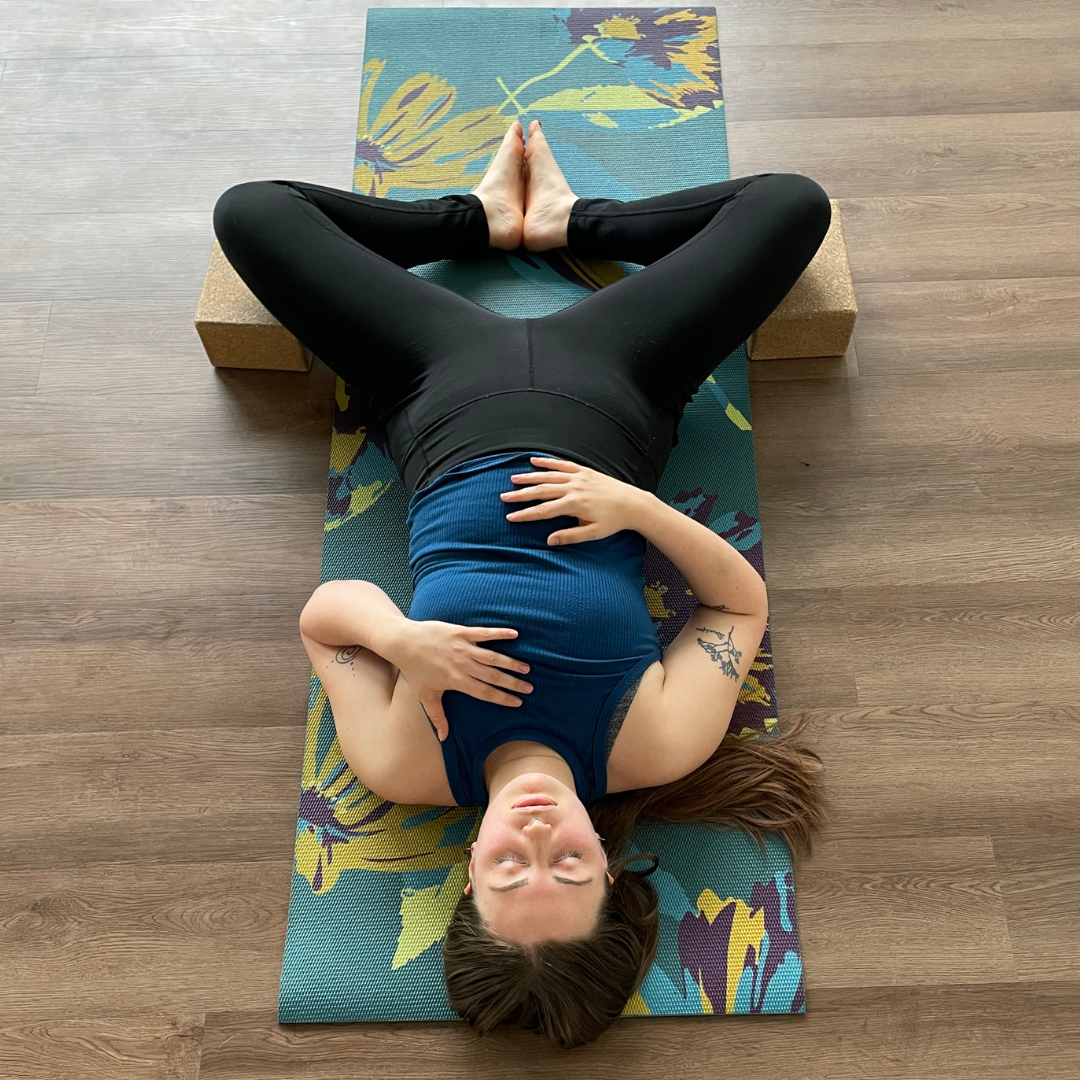
Supta baddha konasana is a perfect place to observe what balance feels like in our bodies. This position allows us to divide our left and right sides, and spend time sensing the differences and similarities, and how we might accommodate each to feel balanced.
- Begin lying on the floor with the legs long.
- Slide the feet in towards the body so that the knees point to the ceiling.
- Open the knees wide like a book, letting the soles of the feet press together. Let the heels of the feet be as close or far from the pelvis as is comfortable.
- Arms can rest anywhere that feels comfortable.
- Hold for 7 – 10 breaths before gently closing the knees and coming out of the pose.
Balance is not always perfectly symmetrical, especially in our bodies. In fact, we may find that one side of our body needs different accommodations than the other side in certain poses. Can you sense that in baddha konasana? Perhaps you notice one knee is more lifted than than the other, and you explore adding a gentle weight to the higher thigh. You may notice that one leg feels tighter and more tensed than the other, so you explore bringin a block beneath that thigh to signal support for release. Allow yourself to explore balance through asymmetry.
Active Pose of the Week: Adho Mukha Svanasana (downward facing dog)
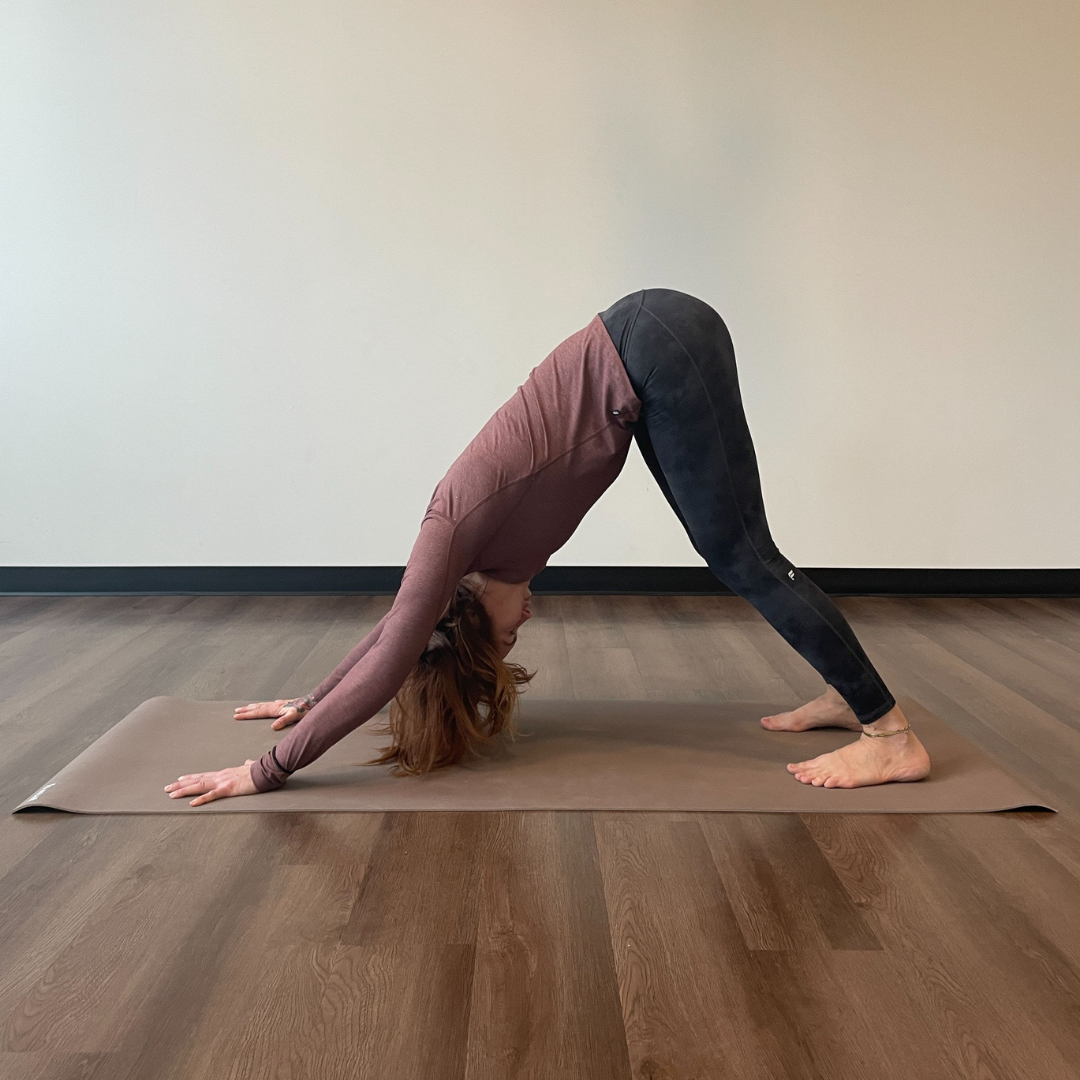
Downward facing dog is a position where folks often sag or sink the chest into the pose or resist and stiffen up in the back or hips. Can we work to find a sense of “yielding” in the pose? Where we interplay with gravity and find a balance between the effort and the ease? The tension and the softness?
- Begin in a tabletop position, with your hands and knees on the floor.
- Tuck your toes, lift your knees and press your hips up and back, reaching away from your hands.
- Think about making a triangle shape with your body. If it is more comfortble, keep a soft bend in the knees.
- Hold for 3 – 5 breaths and come down.
If you are new to yoga spending a lot of time on your wrists can be challenging, afterall, you are bearing all of your body weight on the wrists! If you find that downward facing dog is bothersome for your wrists, you may need to spend some time progressively building a tolerance to this position. Rather than spending time in a position that bothers your wrists, allow yourself to take breaks in class, to relax the wrists. Gradually build yourself up to spending more time in your down dog. At home, you can practice holding the post for 5 seconds at a time, for 3 – 4 rounds. Do this 3 – 4 times a week, and after a few weeks, build up the amount of time you hold the post to 10 and then maybe 15 seconds. This will allow you to progressively load your wrists and become more tolerant of the position.
Join us in class this week to practice finding your balance of effort and ease. See the full schedule HERE.
To get weekly updates from our parent brand, Myriad Fitness + Yoga, follow our weekly podcast “For Time.”