“Surrender is a journey from the outer turmoil to the inner peace.” – Sri Chinmoy
Weekly Focus: Isvara Pranidhana (surrender to that which is greater)
Ishvara Pranidhana is one of the five Niyamas outlined in the Yoga Sutras. It is the act of surrender, surrendering to something greater than ourselves. Through the act of surrender we accept our lack of control and invite a space of serenity into the mind.
What does it mean to surrender in the practice of Yoga? To surrender is to release our attempts at control, to accept our lack of power and to understand we aren’t always in charge. Ultimately, it’s the biggest release of attachment we can offer. That maybe sounds a little unnerving, and it is. However, when we give into surrender, we also experience freedom, a freedom from trying to meet imagined expectations, a freedom from trying to achieve perfection, a freedom from working for outcomes. This acceptance is an invitation of serenity into our hearts and our minds.
Building off of last week’s theme of Namaha, Isvara Pranidhana is a continued and deep de-centering of the ego. When we invite surrender into our every day, we start to see the bigger picture in life. We see ourselves as a single strand in the web of life, a single blinking star in the whole of the Universe, a drop of the divine. The actions we perform matter, but perhaps not in the ways we formerly believed.
Isvara Pranidhana is an invitation of the spiritual into our hearts. An invitation of trust that we will find our way. An invitation of acceptance and peace.
When is it hardest for you to release control in your life? How do you feel in moments when you do invite release?
Passive Pose of the Week: Supta Baddha Konasana (reclined bound angle)
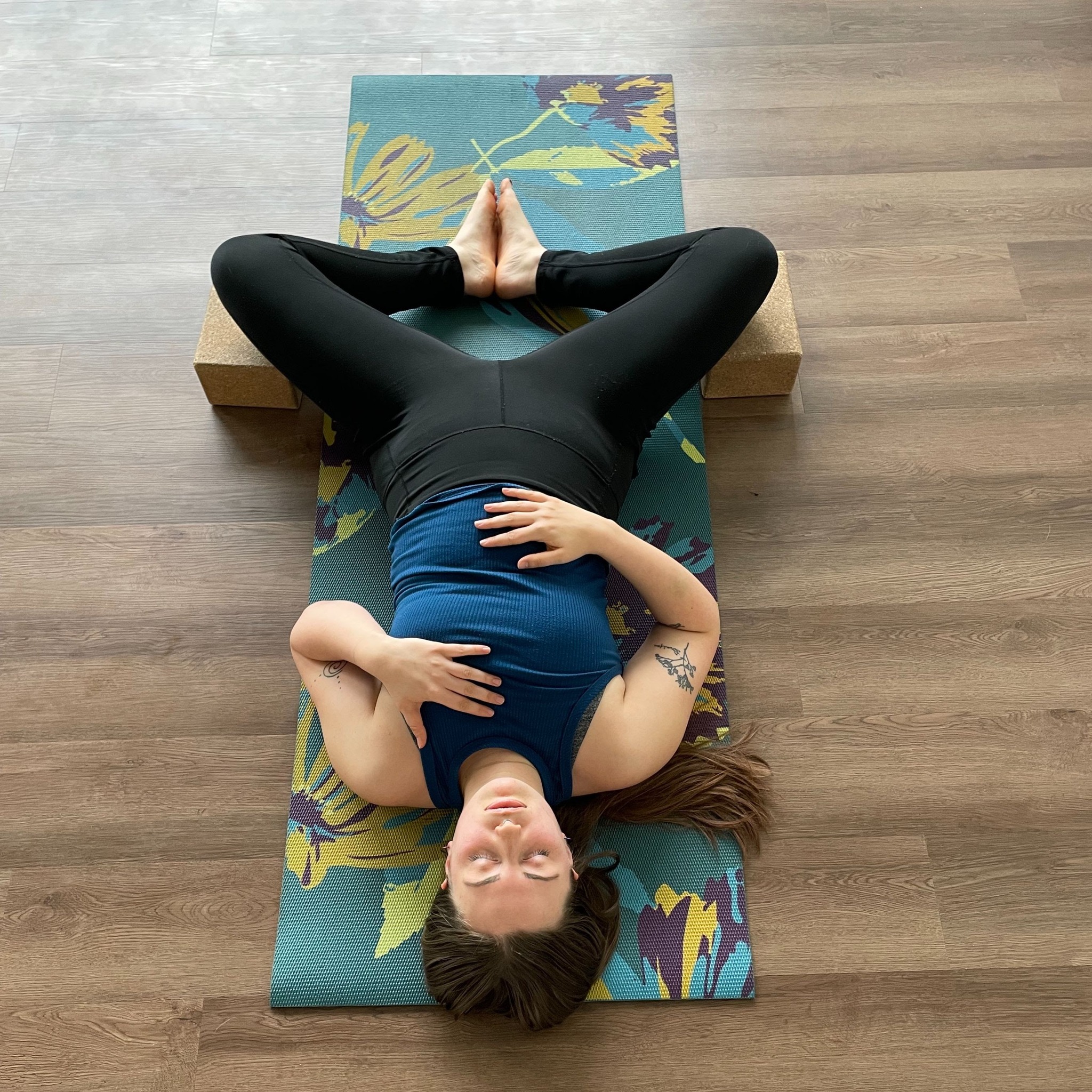
Supta Baddha Konasana is a cooling and soothing yoga posture that invites a release of the body and open-heartedness of the spirit.
- Begin lying on the floor. Pad the had with a yoga blanket for comfort if you prefer.
- Slide the feet together so that the soles of the feet touch.
- Allow the knees to open up like a book or butterfly.
- Slide yoga blocks or rolled yoga blankets behind the back of the thighs so that the legs can comfortably relax into the pose.
- Stay in the pose for at least 2 minutes and up to 5 minutes.
- As you are ready to leave the pose, take your time to close the legs and slowly bring back your awareness.
Supporting the back of the legs in this pose is key to being able to hold the stillness for an extended amount of time. Most individuals will have the knees floating to some extend while in this position. Without a surface beneath the legs, the muscles will try to hold tension to keep the legs in place, eventually shaking or aching and becoming a distraction. When we fill the space between the legs and the floor, the nervous system quiets and we don’t need to “work” to hold the position. This lets the body relax more fully so that we can surrender into the pose and move away from the distractions of sensation.
Active Pose of the Week: Parivrtta Ardha Chandrasana (revolved half moon)
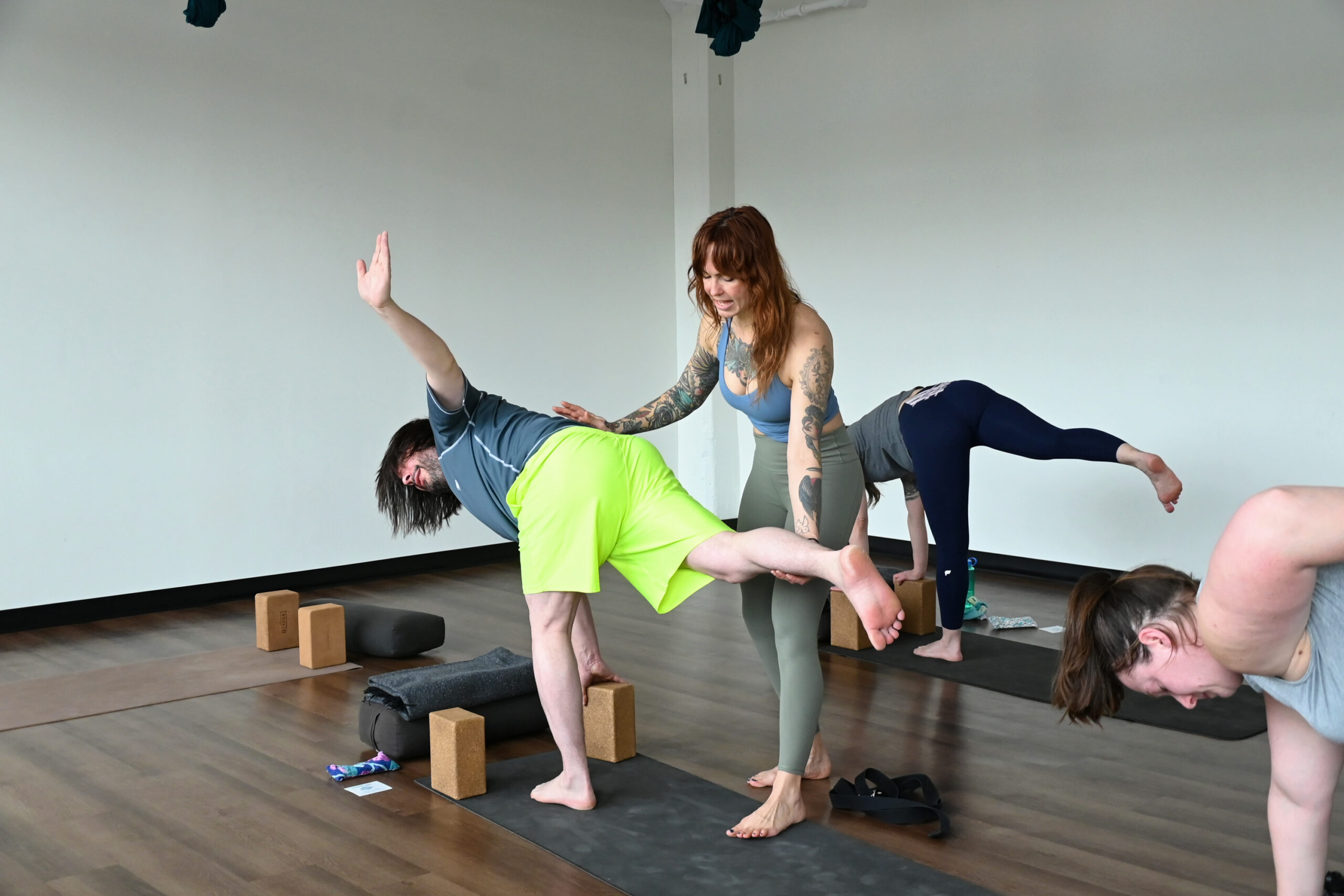
Parivrtta Ardha Chandrasana is a challenging balance and twist. This yoga pose rarely looks or feels how we may expect it to – an excellent practice in releasing our expectations and attachments to achieve. This release invites a space of learning, curiosity and experience into our practice.
- Begin in a standing Mountain pose (tadasana).
- Fold forward and bring your hands to yoga blocks.
- Move the yoga blocks a little forward of your shoulders, push into the blocks and extend your spine.
- Keep the back extended as you lift the left leg into the air behind you.
- Keep your left hand pressing into the block and begin to twist towards your right. As you do, bring the right hand to your right hips. Open the chest to the right.
- If it feels comfortable, you can reach the right arm up to the ceiling.
- Hold for 3 – 5 breaths and switch sides.
This pose is tricky! We may have an idea of how we want this pose to look or be, but that may not be our reality. Yoga props can be used to help us experience more in the pose, if we are able to release our attachments to achievements. Surrendering to support provides more freedom to explore the pose. Try using a folding chair and the wall. Come near a wall but face away. Have a chair in front of you with the seat facing you (make sure the legs of the chair are on your sticky mat!) As you come into the pose, place your left foot on the wall so that you can press and straighten the left leg into the wall. Use the chair for your left hand so that you have more space to twist and rotate rather than reaching for the floor. Use the balance of pressing your foot in the wall and pressing your hand into the chair to experience more length and breadth across the body. How does this compare to your usual revolved half moon?
Join us in class this week to practice your self-reflection and acknowledgment of the Kleshas. See the full schedule HERE.
To get weekly updates from our parent brand, Myriad Fitness + Yoga, follow our weekly podcast “For Time.”