“I would love to live like a river flows, carried by the surprise of its own unfolding.” – John O’Donahue
Weekly Focus: Apas Tattva (the water element)
Apas Tattva is water, one of the five great elements in yogic cosmology and Ayurveda. Apas contains many qualities, some of which are fluidity and adaptability. Like the ever-flowing current of a stream, water is constantly taking new form, flowing and moving with life.
Apas Tattva sets the tone for the month as we focus on finding a sense of adaptability through transitional seasons of life. Water has capacity to take new shape, direction and property while still maintaining its absolute essence. Whether cutting through rocks in a river bed, transforming into a gas or solid, it is still water.
Yoga doesn’t ask us to change from who we are at essence. In fact, we are reminded to stay authentic to our nature. Yoga does ask us to find a flow with life however. We don’t change who we are but we find ways to adapt to new circumstances, challenges and people so that we might feel more light-hearted.
When we feel ourselves resisting the discomfort of change we can turn to Yoga as a guide to navigate the struggle. Through the practices of movement, pranayama, reflection and meditation we can better understand the roots of our resistance and break down barriers to flow through.
How do you process and navigate change or transition in life? What tools from Yoga help you? Can you recognize when you are resisting change or adapting and accepting change?
Passive Pose of the Week: Prone Twist
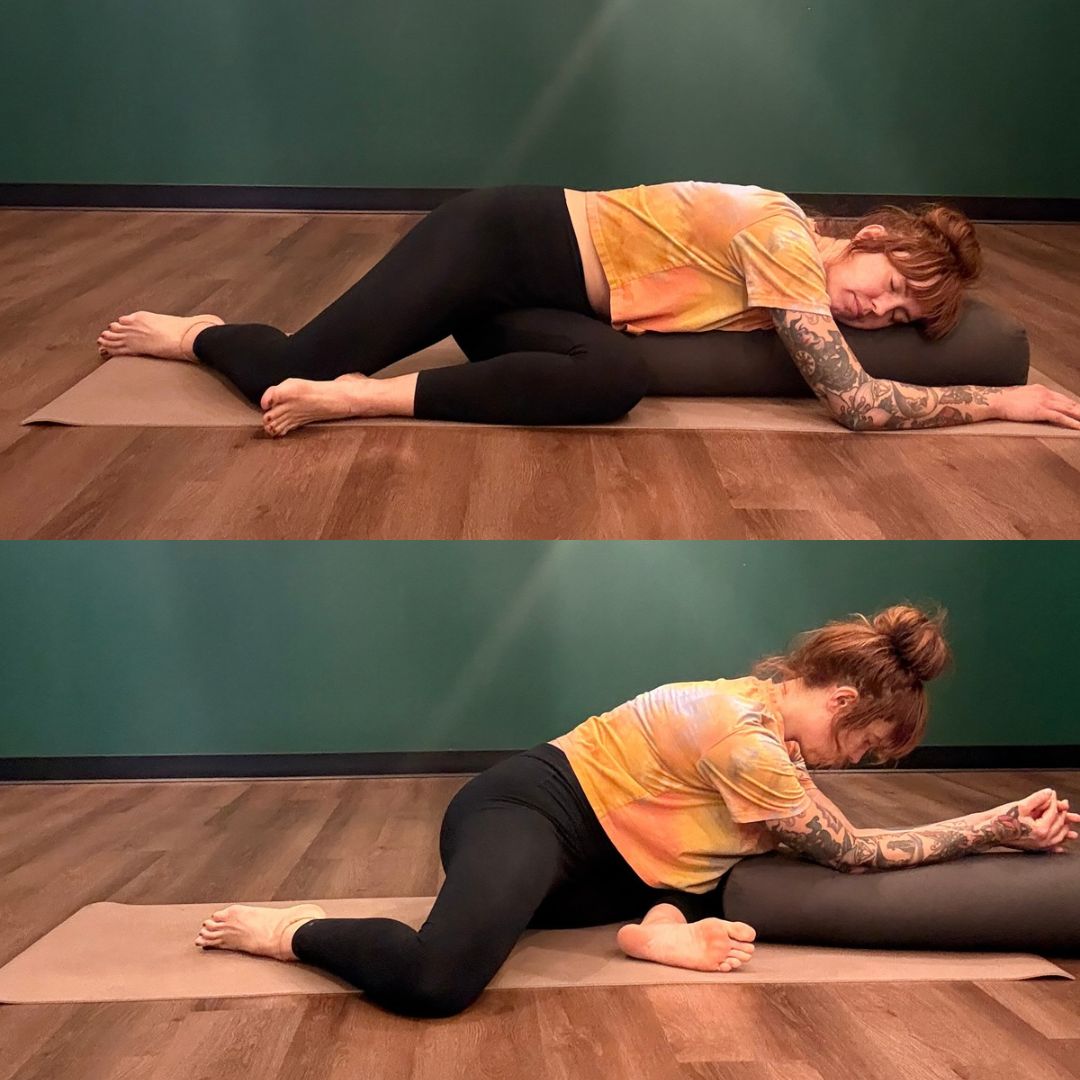
Prone twist is a gentle twist and forward fold. Both of these positions help to move around stagnant energy that my leave us feeling stuck or caught in transitional space. Metaphorically it helps us leave behind the what was and welcome what will be.
- Begin sitting on the floor with the legs straight out in front of you.
- Bend your knees and widen your feet slightly. Rock the knees over to your right.
- Turn your chest to the right and rotate so that you are turned towards your right thigh.
- Walk your hands forward and lower yourself to your elbows or perhaps to a bolster so that you can lie down on your chest and belly.
- Hold for 5 – 7 breaths before coming out and switching sides.
A prone position in our twist allows us to experience more rotation from the base of our spine up through the neck. Some people will find they have more access to twist here than they do on their backs. So often a supine twist doesn’s actually twist through the whole spine due to mobility limitations. By staggering our legs and placing a bolster under the belly we allow the body more ease to experience a full spinal rotation, the true goal of the pose.
Active Pose of the Week: Urdhva Mukha Svanasana (upward facing dog)
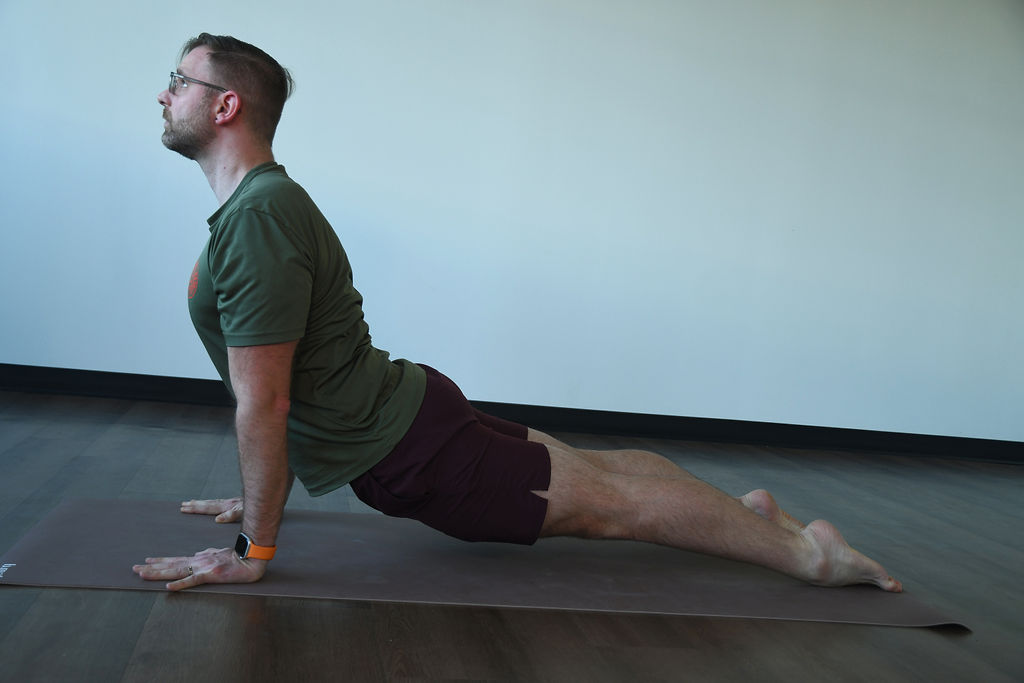
Urdhva mukha svanasana is an energizing posture. It has the ability to help move your flow of energy to more uplifted state and builds a resiliency and fluidity in the body and spine.
- Begin lying on your belly.
- Place your hands a little wider than the shoulders with the fingers slightly turned out.
- Push into the hands and lift your belly, chest and shoulders from the floor, creating a back bend in the body.
- Push down more through your hands and also the tops of your feet lifting your thighs from the floor.
- Hold for 2 – 3 breaths and slowly lower down, maybe finding a childs pose to rest after.
This yoga posture can often get confused with cobra pose, another prone facing backbend that lifts off the floor. So what’s the difference? Cobra pose lifts the upper belly, ribs and chest from the floor and may not always feature straight arms (depending on the practioner’s body). Upward facing dog has a more active push through the hands and the tops of the feet which allows the low belly and hips to lift from the floor as well. Depending on the length of your arms you may feel the thighs and even shins float from the floor. Cobra is often a more severe backbend and engaging of the upper back while upward dog is a longer more spacious backbend stretching across the belly and hip flexors.
Join us in class this week to practice finding your flow. See the full schedule HERE.
To get weekly updates from our parent brand, Myriad Fitness + Yoga, follow our weekly podcast “For Time.”